Wednesday, January 25, 2012

Ravenous Review


Sup, delicious humans! 

I have missed every single one of you, as I hope you did me.  I beg you pardon my triple month disappearance, but I have been taking culinary classes.  I am currently perfecting my recipe for toddler tartar.  It’s coming along pretty well, though I must admit I am having a little trouble with the marinade.  If anyone is interested in following my chiefscapades, you will be glad to know that I will soon provide you step by step instructions on the preparation of my new dish.  That is, as soon as I manage to get my hands on a real kitchen, rather than a leftover hotplate I found in the depths of the closet. 

The series of events that stimulated my interest in the culinary arts unfolded after a private screening of the hunger pain inducing movie, Ravenous.  The movie is set in the mid 1800’s during the Mexican American war.  Lt. John Boyd (Guy Pearce) is granted a promotion after he single handedly captures the enemies’ fort.  However, Boyd’s superiors don’t feel he is worthy of his new post, since the methods implemented to accomplish his goal were embarrassingly cowardly.  You see Boyd really doesn’t have the stomach for violence.  Early in the battle he played possum, watching his company fight and die around him.  As he waited out the carnage, he accidentally sampled some blood from a dead soldier.  Upon consuming the blood he discovered that it had rejuvenative powers, enriching him with a newfound vigor. Pumped, he snuck out from under a pile of bodies and singlehandedly captured the enemies’ fort, winning the battle.  However, unable to let Boyd’s initial cowardice go unpunished, his commanding officers ship him to the remote Fort Spencer in the Sierra Nevada Mountains, where they could be sure he would never see action on the battlefield again.  There, he meets his new unit consisting of such appetizing human actors as Jeffrey Jones and David Arquette.  

Soon after Boyd gets himself situated, a strange man collapses just outside of the Fort.  His name is Mr. Colqhoun and he is one of the last survivors of a lost caravan somewhere in the Sierra Mountains.  Once his party’s food supply disappeared, they were forced to eat their dead in order to survive.  They kept that going for as long as possible, but once their numbers dwindled to nothing, Colqhoun decided to flee from the party in hopes of finding help.  With this morbid story, Colqhoun successfully convinces everyone there is still a survivor in the woods eating the last of his party members.  Feeling obligated to help the poor souls; the soldiers and Colqhoun embark on a journey to save the lost survivors.  Unfortunately for them, they soon realize that they are actually the victims of a horrible trap.  So of course, culinary hijinks ensue.

(FYI, Colqhoun is pronounced: COLQ like COWL and HOUN as HOON like the word SOON). 

Three elements of the film really stick out at me as particularly well done: the choice of monster, the acting but most of all the music.  The scrumptious human Antonia Bird is the director of the film, and I am rather surprised at how good of director she is.  For a short while, I wondered why I hadn’t heard of her before, but then I learned she mostly directs British Television.  It’s hard enough to tap into the walls of the house I squat in and steal American cable from the Groves, so there is no chance in hell that I would ever have decent exposure to her work.  It was also surprising to see that Antonia’s genre of choice is generally not horror.  I have seen many other movies from people who have dedicated their lives to make horror pictures and still cannot pull together a good suspenseful piece like this, even in exchange for the key to the basement I locked them in (I’m sure Herschell Gordon Lewis will claw his way out of that rat trap some day).  This movie’s existence is rather refreshing to me, because it proves that really good movies can (and often do) slip through the cracks of mass audience appeal and/or exposure.   It gives me hope to continue digging through the annals of bad movies in hopes of finding those ever elusive hidden gems of the film world.  But most importantly, it makes me hungry.


The monster isn’t all that common in most modern horror movies.  Sure, we have all watched episode two of Supernatural, but besides that, I don’t right recall many horror movies about this particular cryptid (I am not counting the 2001 horror film Wendigo by Larry Fessenden…I want to save that discussion for another day).  In case you have never heard of a Wendigo, it is an Algonquin mythological beast that was once human, but has transformed do to the over consumption of human meat and possession by an evil spirit.  They behave like wild animals, prowling the night in search of victims.  Though the Wendigos in this film behave a lot more like vampires than wild animals.  They spend their time mingling with humans, but only as a ruse to cover their morbid actions more effectively and choose who their next victims will be.  The Wendigos powers are also vampiric in nature; eating human meat gives them a significant boost to their immune system and increases their strength and stamina.  With that said, why not make this a vampire film?  

Though this movie would have been just fine as a vampire flick, making the monsters Wendigos with vampiric traits allows the audience to instantly sympathize with the unfamiliar monsters in a familiar way.  For the past twenty five years, the market has been over flooded with content about those pasty faced lust buckets, usually written for prepubescent human twats.  I feel confident in saying that when it comes to vampires, we want to see something very new; Anne Rice filled the quota for whiny vampires for the next half a century (Someone forgot to inform Stephanie Myer).  Using a different monster opens the doors for old topics to be made fresh without the conflict coming off as too old hat.  There is little Wendigo content to dispute the nature of the beast, that it is ok to incorporate new ideas without pissing off your average Wendigo fan and still managing to captivate a massive audience (once again, somebody forgot to inform Stephanie Myer).  We can discuss such topics as addiction, the natures of good and evil, and of course, the morality of survival tactics without leaving the audience yawning the ever famous mantra while leaving the theatre, “John Carradine did it better”.  While the film sadly didn’t succeed in captivating a mass audience at the time of its release, using an unfamiliar monster at the bare minimum provided the film with a hint more originality than it’s standard blood sucking compadre.  But what is a really original monster without a good cast to help bring the creature to life?


A good ensemble cast requires good talent, just as a delectable Shepherds Pie requires a sweet, juicy carcass.  The casting of Ravenous is one of the movie’s finer sweet spots to be sure.  The delicious human actors Guy Pearce and Robert Carlyle work off each other so well, playing characters that have completely polar opposite senses of morality.  

Boyd is a pragmatic pacifist, who adheres violence, unless under the threat of bodily harm.  Though, because he is a soldier and killing is his job, his desire for self-preservation frequently causes others around him to get hurt, which is why he is often labeled a coward.  This is seen by his initial action of playing dead during the Mexican American war.  It is also seen as he tries to run away, even when Cl. Ives has just killed his fellow soldiers outside of the cannibal cave (I’m not really spoiling much, this happens too early on in the movie to ruin).  I must admit I have never seen another Guy Pearce movie, and I am glad to have this be my introduction to his work.  His ability to internalize the conflict and project the pain it causes his character onto his face generates a great deal of sympathy.  I also enjoy watching his frustration grow as he fights to convince his fellow soldiers that Ives is in fact a man-eater.  Even more enjoyable is the look he gets every time he is mortally wounded and must either eat human flesh or die horribly.  You can almost see the back and forth going on in his head up to the very second he decides, “fuck it” and finally digs in.  It gets me every time.  

To noms, or not to noms.
Cl. Ives (Robert Carlyle) on the other hand plays a complete Nihilist; he feels no remorse for his insatiable appetite and even embraces it as his nature, which he would gladly sate at any point.  Carlyle plays the part with such an unapologetic dispensation that you can’t help but fall in love with him.  You even begin to sympathize with him as you learn about the unfortunate events that brought him to choose the life of a Wendigo.  His actions aren’t justified, but the appeal of watching him is seeing how Carlyle makes Ives feel justified for eating people.  Hmmm…Understanding the monster to a point that you humans may finally know why we do the things we do.  What a novel idea.  Take a note, human horror film makers; I want more of this.  If I wanted to watch boring, one dimensional, teenage characters face poorly written conflicts, I’d watch Glee.


Despite the talents of our two leads, my favorite two human actors by far are Jeffrey Jones and David Arquette.  

This film proved to be one of the last of Jeffrey Jones’ acting career of the millennia (he followed up with Tim Burton’s Sleepy Hollow).  Though I can’t condone anything he may have done for his presence to significantly diminish from the Hollywood circuit, his performance in Ravenous is a bittersweet reminder of how much his talent is missed on the big screen.  Jones plays Col. Hart, Boyd’s superior officer at Fort Spencer.  He is a crippled and sickly old man who takes a shining to Boyd, as he is one of his few fellow soldiers with a tortured past and conflicted disposition to match his own.  Hart was once a mountain of a man, but in his old age grew sickly and frail.  He loves to read philosophy (he quotes Benjamin Franklin and Aristotle) and eat walnuts.  Despite his overqualified credentials, he has resigned himself to the glorified position of father to a bunch of drunken and “overly medicated” ninnies working beneath him at this baron way station.  You see him crave his youth, as he smashes a handful of walnuts with a thick heavy book, even though he was once strong enough to squeeze the nuts free with his bare hand. All the while he watches his life slink slowly down the drain of mediocrity and thankless employment.  Actually, Col. Hart is one of the main reasons why I keep coming back to watch this movie.  He goes through such an interesting character arc so Faustian that I can’t help but love the on and off screen drama of this character.   Jones seamlessly slips into this performance, playing a resigned man to his midlife misfortunes and his loss of control over his own faculties.  Actually, reflecting on this can be very eerie on dark and stormy nights.  It is tough not to notice the similarities in tone of Cl. Hart’s frustration and Jones’ own current real life situation.  One wonders if Cl. Hart’s Vonnegut esque (“so it goes”) attitude on life is not too dissimilar to Jones’ about his status as a Hollywood celebrity.  I suggest you read up on the man, watch this movie, and heed my words.  You may enjoy the frosty chill of celebrity misfortune.

Finally, I feel the need to talk about the performance of the human actor David Arquette.  He plays Cleaves, a low ranking private in Col. Hart’s regalia.  Cleaves spends the majority of his free time smoking marijuana and eating peyote.  Despite my initial low expectation of this performance, I am happy to report that Arquette far exceeded my expectation.  The stereotypes of the drug fiend have become so familiar that most portrayals tend to be more of a parody than an authentic emulation.  However, Arquette depicts the attitude of a reckless but loving adolescent rather than a Ninja Turtles Stereotype.  But Arquette’s real shining moment is during a grizzly dream sequence, where Boyd stabs Cleaves and goes to town chomping down on his liver.  As Cleaves slowly dies, he laughs antagonistically at the sight of Boyd giving into his darkest hunger.  The scene only lasted for about half a minute, but this one performance reminded me of another actor well versed in the portrayal of bit creepy parts, the late and great Dwight Frye.  Specifically, what comes to mind is Frye’s performance as Renfield in Carl Laemmle’s Dracula.  Renfield begins the movie as a straight man, with no particular substance to him other than his desire to sell some property in London to Count Dracula.  But after Dracula submits him to obedience, Renfield becomes a twisted nutcase with a morbid hunger for insects.  The transformation between these two very different personalities is seamless and makes the character intimidating, since his personality shifts so abruptly.  It is an art to give a side character substance and diversity, especially when that character has so little on screen time.  But for Aruqette to win me over, it only took a laugh.  For This performance, I offer Arquette a blood-curdling scream of approval.


The music is very peculiar in this film.  The tasty human composers, Michael Nyman and Damon Albarn did a fantastic job creating a series of haunting melodies, which alone are eerily beautiful, but juxtaposed to the gorgeous cinematography, make for some fascinating content.  The gritty composition really puts you into the world of this 18th century military fort in the Sierra Mountains.  The music sounds like it was written and recorded a long time ago by some primitive backwater jug band, yet the music itself would translate beautifully if performed by a philharmonic orchestra.  The awkward playing of the musicians and the off key instruments they played on created a foreign and unsettling atmosphere, giving character to the beautiful scenery portrayed throughout the movie.  In this way, it mirrors the gritty music often used to set the stage for such period pieces as “Once Upon A Time In The West” and “A Man For All Seasons”.  It’s that grizzled and dated edge in the music that really helps capture the flavor of the setting and set the mood for this piece.  It also sticks out to me as the most identifiable aspect of this movie.  It just goes to show you how much a good score can affect your film.  

If you are looking for a brilliant and rare horror movie, Ravenous comes highly recommended by yours truly.  The monster is original, but incorporates familiar character traits of other monsters to keep it fresh.  Also, every character and performance is authentic and distinct.  But to top it all off, the haunting composition draws you in and keeps your ass planted firmly in your seat from start to finish.  At the end of the day, these details are simply that; details.  But these details make this movie one of my favorite period horror films ever made.  So grab your walnuts, slice your wrists and poor yourself a glass of that ol' Jesus Juice.  Because if his is good enough to drink every sunday, then surely yours is good enough for the rest of the six days of the week.


*Just a quick note about Vampire films.  I don't think vampires are on their way out.  I am only saying that they are embedded much deeper into the mainstream than Wendigos are.  Thus, making an original Wendigo movie is a lot more easy than an original Vampire movie.  

**By the way, expect a lot more content from me this year.  Jeffrey is stepping out to paint the town with buckets of Babies' Blood.

Saturday, October 29, 2011

Shockfest Host Application

I have finally decided after 800 years to take a step out from behind the closet door and take on the moving pictures industry by its devilish horns.  Get ready Hollywood.  Here comes Jeffrey.


Come check out more about shockfest here

Friday, September 23, 2011

FemVamp.com Review


You know what I like in my pornography?  Blood, mutilation and a plot.  The problem is that the only porn worthy of my erection is my gory scissor reel of Eli Roth movies (unfortunately, such films lack a plot, making it very difficult to enjoy a good old fashioned blood orgasm…But this is a discussion for another day).  Luckily I recently stumbled upon something far more entertaining than any monstrous spank material put out by a thousand Eli Roths powered with atomic rays.  This tasty title of titillation is called Femvamp.com, a horror comedy internet show about a clan of sex crazed female vampires who lure unsuspecting viewers to their doom through their porn website, femvamp.com. 

It's not ok to hit a child, unless you
make it look like an accident
Like a horny teenage prom date with an initial fear of the almighty penis, I was titillated yet hesitant to jump into bed with this piece upon watching the first episode.  My brows frilled at the exposition delivered by some loud-mouthed jockey boy.  But as soon as said jock became the first victim of a vampire babe in a corset, I realized that what I had just watched was nothing more than a prologue meant to introduce the theme of the overall show, which is very tongue in cheek.  Just like how Judd Nelson slipped the panties off of Molly Ringwald in “The Breakfast Club”, this webseries managed to charm me instantly after the very catchy theme song played juxtaposed to two voluptuous vampire women spreading gratuitous amounts of fake blood all over their human female victim’s mostly naked body with their mouths.  Instantly, the show introduced who would eventually become my favorite character, Detective Valentine.  In the first two minutes, the bitch-slapping cop (played by Jay Bingham) knocks around a baby face student under the suspicion that he is a murdering peeping tom at the local college.  His constant shouting of “bullcrap” and frequent slaps in the face of a kid probably not old enough to buy beer at your local Bevmo was honestly one of the funniest things I’ve watched in a while.  The best part is that Bingham plays it straight, even when the characters in the show realize how ridiculous this guy’s fast fisted tactics are.  I mean it, every time he slaps someone, which is a lot; they either gaze at him blankly and confused or they start laughing at him.  To which his response is to slap them again, for they don’t seem to realize how much he means business.  He even goes so far as to shout at his boss when he gets kicked off the case for his use of excessive force.  I just love how over the top he is with his bad cop routine; it’s as though he’s got something to prove but no one seems to take him all that seriously.  This is the kind of guy who goes home and beats his wife over a miscommunication about why she was out so late with the girls the night before, after drinking his 6 pack of Milwaukee’s Best of course. 

Sometimes, it takes a man with a really sexy O-face

By the fifth episode, the main cast of characters is set up, as are their relationships.  Terry, the protagonist (also the campus pepping tom…but not the murderer) and his best friend BJ, a Chris Brown-esque side kick team up with Professor Wang, a whimsical and flirtatious college professor/vampire hunter to take down the Femvamps and stop their sexy murderous webshow.  All the while, Detective Valentine continues to hunt down Terry, for he thinks he is the one murdering the local college students, even though Valentine has been kicked off of the case due to his violent and silly tactics of retrieving information.  Most of these characters are likeable.  Though I do admit I am not a fan of BJ (he’s mostly played up for laughs and I was never a fan of Chris Brown’s humor) I feel there is a great deal of room for growth with the character, so I am more than willing to stick around and see where it goes.  The jokes that hit, hit very well, and the use of back-story adds a great deal of likeability to the characters.  Specifically, we get a wonderful opportunity to see our “Van Helsing” character, Professor Wang as a young man training to be a vampire hunter.  As it turns out, he was very different as a naïve fledgling pupil studying the art of vampire murder.  I’d love to see more vignettes like this one peppered throughout the series.  It allows us to see our heroes in different stages of their lives thus getting to know them beyond the masks of their social personalities and idiosyncrasies.  The second most important selling factor of this show is the clear level of fun the cast is having while performing and frequently that alone is enough to keep my attention.  It’s really ok to chew the scenery, so long as the scenery is made up of delicious blocks of ham and cheese. 

 It is also worth mentioning how much I like the art direction.  It is especially impressive, since the series has a fairly low budget.  Most low budget projects can’t seem to grasp the idea that filling the negative space in the frame makes the film’s environment look more authentic. But this filmmaker goes out of his way to make the locations look lived in and the props look real.  On a shoestring budget, they build a pretty comfy looking coffin big enough to fit two bodies (kind of reminds me of the crypt of carnality I built in my basement.  You know what I say, when the tomb stone’s-a-rockin…).  Professor Wang sports a crossbow, a vest packed to the teeth with ammo, and giant syringes filled with silver liquid nitrate.  These fine details are what make this show stick out to me as well thought out.  

Miles Whitmon fantasizes about some pretty sick shit, apparently

There is only one thing I don’t like about the show, and that is the method in which jump scares are implemented.  The use of jump scares in the horror genre is one of the oldest and easiest approaches to literally force audience members out of their seats.  The basic formula of an effective jump scare is as follows…

1.              The Setup, or the introduction of a foreign element into a sequence (i.e. a strange noise down the hallway).
2.              Followed by a suspenseful build up used to create tension, (the character’s curiosity is perked and they are unwisely drawn to the mystery).
3.              Finished off with the reveal of something wicked, usually accompanied by a sudden change in volume and intensity of the score and the action (without warning a loud music sting breaks the suspenseful silence and a hellish abomination pops out from the darkness to kill our curious clod).

One of the most famous and in my opinion best examples of an effective jump scare is from the film House on Haunted Hill.  Two guests of a party (a man and a woman) at a haunted house search the basement for a mysterious attacker that may still be hiding somewhere.  They find that the walls in certain spots in the basement are hollow and soon enough the two split up to figure out why.  However, the young lady is unfortunate enough to discover…well, perhaps it would be best for you to see for yourself what she discovers.  


I can definitely see where the filmmaker was going by incorporating jump scares into his series.  After all, a good horror comedy joins both dread and comic relief into a beautiful unholy matrimony.  But I feel the execution of the jump scares were harsher on the ear than on the heart, for they begin with a brief silence followed by a particularly loud sting.  In fact, the loud sting hinders the scare, for when I turned the volume down to mute and watched it again, they were significantly more effective.    But since the jump scares take up about a second or two of only two or three episodes, it is more than fair to say that I am splitting hairs in this critique.

Femvamp.com has the attributes of a high school charmer.  Its personality is both cocky and funny, able to unapologetically make a face palm joke as if to say, “if you don’t like it, someone better will”.  That’s the kind of gusto I appreciate with my humor.  If you take the content of an Ed Wood movie and the delivery of a PG13 cut of a John Waters film (good luck ever finding one) you will be pretty damn close to the feel of Femvamp.com.  If you dare incur the wrath of a fine assed blood sucking leech in hopes of cumming blood all over your Mom’s new carpet (as I know I did before I ate the harlot), go watch the show and tell me what you think.   And remember to keep an eye out for Detective Valentine, I hope that once this show has released a couple of seasons, he gets his own spinoff titled “BULLCRAP!...SLAP!”


Come check it out here.  You'll be glad you did.

Tuesday, September 20, 2011

Daddy of the Dead Review


Not since the Charles Manson cut of To Kill a Mockingbird have I seen such a heartwarming story.  “Daddy of the Dead” is a lighthearted romp about the hardships a father must face while raising an undead child in a post apocalyptic world.  Such conflicts include racism, dietary issues and of course, bigotry.    I consider this film more political than anything, as it takes a very clear position on the issue of undead parenting.  Though I happen to agree with the stand the film takes on said policy, I do have a few critiques on some of the technical aspects of the filmmaking. 

Though I appreciate the message the film conveyed, I think it would have added to the overall viewing experience to create a happier feel with the music selection during the sequence when the father prepared his daughter’s meal.  It would have created a moment for the audience to see the bright side of raising a living dead baby.  After all, a bouncing bile filled child does bring cheer to any loving household.  It also would have made the finale more unexpected and suspenseful.  I was also not the biggest fan of the chosen camera used to film this PSA, but nothing really compares to good old fashion 16mm, and who can afford film to shoot a doc with these days besides Ken Burns and Michael Moore?  Sometimes, stories need to be told and in such cases, any working camera is a good camera. 


Even though our poor subject is most definitely a victim of bigotry and racism from a mob of extremist ghouls, I can’t help but feel the film’s mission to fight racism ends up making the film maker look a tad racist himself; against zombies that is.  After watching it a second time, I noticed the film maker did not go out of his way to interview any liberal zombies who may have taken the living father’s side.  This leads me to believe one of two things; either the film maker is attempting to label all of the living dead as ignorant right wing trailer trash, or the film maker does not understand that zombies are as diverse a race as humans (I should know; I was an attendee at the Zombie Tea Party Rally this past weekend…it didn’t end well).  I am also a tad surprised that the film did not end with a message to its audience, informing them of ways they can help fight the bigotry humans face against their zombie brothers.  Perhaps a link to the website of an organization designed to fight such oppression.  Well that is where I come in.  If you have been moved by the message this film conveys and you wish to help such parents as the one portrayed in Daddy of the Dead, feel free to contact The Zombie Squad and ask them what can be done to make a difference.  They are a charitable organization that works to help those in need under the oppression of such forces of nature as the zombie apocalypse.  They are responsible for running and attending many charitable parties, conventions and events.  I believe they take donations, but either way if you feel so inclined, you can reach them by clicking here.

I usually use a meat cleaver to chop the body into small pieces,
then put the unused parts in the fridge for later.  But a kitchen knife
works fine, if you don't plan on keeping any leftovers.

The film maker's name is Guil Claveria.  I recommend giving the film a look.  It taught me a thing or two about what kind of food to feed a growing ghoul and it does a great job capturing the struggle a parent must face as a minority in a racist community.


Monday, September 19, 2011

The Book of the Law


Friends and lovers, I am rather excited to begin this month’s book club meeting.  So without further ado, let’s talk books.

 You human beings and your religions.  Do Gods have words?  Some say, “Yes they do”.  Can you hear them?  Some say, “Yes I can”.  Can I hear them?  Some say, “Yes you can”.   When can I hear them?  Some say, “Right now”.  What if I can’t hear them?  Some say, “Read the Bible”.  Which Bible?  Some say, “All of them”.  Ok, maybe they don’t say that.  But you will get a whole bunch of different answers from a whole bunch of different people.  It just so happens, that this one particular religious tomb caught my eye the other day and I am rather excited to share it with you.

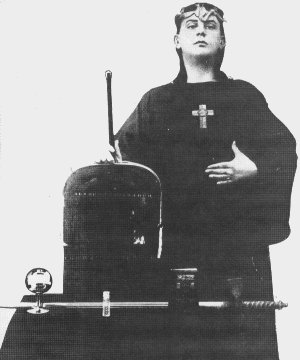
Have you ever been interested in the Qabalah?  Or fascinated by the use of sex and erotica to perfect your ability to manipulate mystical powers from the astral plane?  Then maybe Thelema is the right philosophy/religion for you.   The Thelemic religion draws greatly from the Egyptian pantheon.  Specifically the deities Nut, Hadit and Ra-Hoo- Khuit are considered to be Gods of particular importance.  For they are the heavenly authors of this month’s holy text.

Aleister Crowley, the founder of the Thelemic religion, was a mystic who claimed to share a conversation with a higher being.  Specifically, he was contacted by his guardian angel, Aiwass, The Minister of Hoor-paar-kraat (more commonly believed to be Horus, the centralized deity of Thelema).  Aiwass used Crowley’s fiancee’s body to speak to him in order for Crowley to annotate the bible of his Theleman philosophy; Liber Al vel Legis, or in English, The Book of the Law.

In the span of four days (April 1st, 7th, 8th and 9th) between the hours of noon and 1 pm, Crowley and Aiwaas sat in the drawing room of an apartment in Cairo, Egypt to dictate this magical tomb. 

The writing of the book is both overly complicated and significantly cryptic.  Depending on your desire to dig deep into the will of the Thelemic pantheon or the mind of an insane wizardy-type (depending on your point of view) you may either get a great deal of spiritual awakening from reading this brief dictation, or a great deal pissed off for reading something so indecipherable.  Later in his life, Crowley wrote The Comment, which spelled out the interpretation of his holy book in a concise simple paragraph.  In The Comment, Crowley strictly prohibits any outside study or lecture of the book.  He states that the book must be interpreted privately by ones self only, without aid outside of his own writings and analyses.  He goes on to recommend you destroy your copy as soon as you have read it for the first time.  It was in this brief paraphrase that Crowley defined the book in two simple phrases,

“Do what thou wilt shall be the whole of the law”

“love is the law, love under will”

The definition of “Do what thou wilt” is meant to focus more on one’s spiritual destiny rather than one’s selfish desires.  In thelema everyone has a true will, which is considered to be one’s destiny one must attain.  It is not chosen, rather enlisted to an individual based off of their inner self in relation to the universe.  To attain one’s true self is to attain enlightenment.  A true Theleman’s actions are in perfect harmony with nature, as they use magick (yes, with a K) to attain one’s true will. 

If you wish to read more on the subject of Thelema, I recommend starting with The Book of the Law.  You can read it online by clicking here

If you’d like to read any more of Aleister Crowley’s work online, you can do so by clicking here.

I also recommend Crowley’s autobiographical experience as a drug user, Diary of a Drug Fiend.  At the very least it is worth a couple laughs.

For those of you who wish to read The Book of the Law and are easily lost in Aiwass’ fancy and highly metaphorical prose, I have written up a quick cheat sheet for you to become better acquainted with the meaning behind some of the texts.  Does that make me a sinner in the eyes of your average Thelemic practitioner?  I don’t care.  I’m a horrible monster who lives in a closet and eats people.  However, as this is such a complex piece of writing and I do have a great many babies to toss off of tall buildings today, my cheat sheet does not go so in depth to be a complete analysis, rather a modest glossary of Thelemic terms, metaphors and meanings behind various phrases and reoccurring concepts you will come across by reading The Book of the Law.  If you are interested in reading Crowley’s various essays and commentaries on the book (which go significantly more in depth), I recommend reading his other book, The Law is for All.  You can purchase a copy at Amazon.com by clicking here.


So without further ado, let us begin...

Chapter 1


Nuit 
Heavenly speaker of the first chapter of the book. 
She is the sky goddess, ever arching over her masculine counterpart Hadit, to kiss his “secret ardours”.  (14)

“…and in his woman called the Scarlet Woman is all power given” (15)

The Scarlet Woman is the goddess Babylon, riding bare breasted on the back of the great Beast, whose number is 666 (Aleister Crowley often saved this title, The Great Beast, for himself.  However in this case, he is referring to another deity.  Not Satanic in nature, but Thelemic).

Babylon 
-To her is the “stooping Starlight” as to Hadit is the “Winged secret flame” (16)

Nuit and Hadit are represented as female and male counterparts, Nuit the feminine encompassing Hadit the masculine in her heavenly body.  Crowley is famous for his blatant and cryptic carnality, for sex is a powerful tool in the Thelemic religion.  Keep your peepers pealed.  You are bound to find a great deal of metaphorical soft-core porn in this bible.

-“I am Nuit and my word is six and fifty.  Divide, add, multiply, and understand” (24 – 25)

The use of numbers is very common in many pagan and spiritually based religions.  In Thelema, they are used to uncover many transcendental secrets.  50 + 6 is 56, the number of Nuit.  When broken apart and added together, 5 + 6 = 11, the number of the Tree of Life.  Take special note of the importance of the numbers 5 and 6, for 5 is represented by the Pentagram, the 5 pointed star and 6 is represented by the Hexagram, the 6 pointed star.  Both stars have their own magickal significance.  The Pentagram represents the Microcosm, the four elements Earth, Fire, Wind and Water crowned together with the fifth point, the spirit.  The Hexagram represents the Macrocosm, the points of the star are granted to the planetary bodies Saturn, Jupiter, Mars, Venus, Mercury, The Sun and The Moon.  Put together, the Pentagram and the Hexagram become a very powerful and all encompassing symbol.  As you can see, there is already much to dive into with this mystical text.

The Tree of Life
-“My scribe Ankh-af-na-khonsu, the priest of the princes, shall not in one letter change this book; but lest there be folly, he shall comment thereupon by the wisdom of Ra-Hoor-Khuit” (36)

Interesting tidbit, Cowley actually did make changes to the original manuscript (such as inserting summed up excerpts from his previous work, The Stele of Revealing and various other spelling and grammatical changes).

-“Who calls us Thelemites will do no wrong, if he look but close into the word.  For there are therein Three Grades, The Hermit, and the Lover, and the man of Earth” (40)

The Thelemic Order System has three levels of initiation.

The Man of Earth is the first level of enlightenment, in which the lesser magicks of nature are taught to the novice Thelemite.

The Lover is the second level of enlightenment, in which lessons of the first level are expanded upon with more emphasis on the pursuit of knowledge of the greater magicks of nature.

The Hermit is the third level of enlightenment, in which the Theemic student must follow the pursuit of light and knowledge.  It is where one finds inner and personal enlightenment.  To achieve this is to achieve the highest form of existence and become a Master of the Universe.


Chapter 2


Hadit  
Heavenly speaker of the second chapter of the book
The spirit within all humans.  The masculine counterpart to Nuit.

-“With the just I am eight, and one in eight”

Numbers again.  You can read more about the Thelemic meaning of numbers by clicking here.

-“Now a curse on because and his kin!” (28)
“If will stops and cries Why, invoking Because, the Will stops & does nought” (29)
“If power asks why, then is Power weakness” (30)

“Because” is a rebellious word.  The answer to the question “because” defines reason, and in Thelema, reason is acquiescent to Will.  Crowley states in his later work, The Law Is For All, “It is ridiculous to ask a dog why it barks.  One must fulfill one’s true nature, one must do one’s will”, emphasizing this Thelemic school of thought.

-“A Feast…Aye!  Feast!  Rejoice!  There is no dread hereafter.  There is the dissolution, and eternal ecstasy in the kisses of Nu” (34 – 44) 

Hadit commands you to rejoice on the path of your true will.

-“There is light before thine eyes, o prophet, a light undesired, most desirable…I am the master: thou art the Holy Chosen One” (61 – 65) 

Hadit’s message seems to be directed toward Crowley himself, as Hadit depicts the joyous rapture which comes with the service of dictating this heavenly prophecy.  Crowley would later describe in his piece the old Comment as feeling “swallowed up in ecstacy” while writing this.

-"4 6 3 8 A B K 2 4 A L G M O R 3 Y X 24 89 R P S T O V A L…There cometh one to follow the: he shall expound it” (76) 

Some magicians believe this to be a Cipher, a code, which can be easily solved through a mysterious process. 

A wonderful author, G. M. Kelly attempts to decipher this crypic code through several notes and works of Crowley.  You can read his article by clicking here


Chapter 3


Ra-Hoor-Khuit 
Heavenly speaker of the third chapter of the book of the law
God of war and vengeance (pay close attention to his words, for they are very war mongering)
Lord of the Aeon

-"Abrahadabra, the reward of a Hoor Khut” (1) 

The word Abrahadabra (with an H, not a C) is, according to Crowley in The Law is for All, the mystical formula for this new Aeon, The Aeon of Horus.  The reason is broken down in said book.

-“Sacrifice cattle, little and big: after a child.  But not now” (12 – 13)

Interesting tidbit, Crowley had many children with many different women.  A good portion of his children died in his lifetime.

-“There cometh a rich man from the West who shall pour gold upon thee…and blessing no longer be poured to the Hawk-headed mystical lord!” (31 - 34)

This is a prophesy of the future, involving the formation of the Thelemic church and the oncoming battle that will ensue. 

-Hrumachis – The double lion headed form of Horus.  It is an inverted form of the Sphinx, the body of a lion and the head of a man for Hrumachis has the body of a woman and the head(s) of a lioness.

-Mentu – Egyptian war God, lord of Thebes.

-Ankh-af-na-khonsu – a Thebian priest of Mentu from the 26th dynasty in Egypt.

-Ra, Tum, Khephra, Ahathoor Bes-na-Maut and Ta-Nech – Egyptian Gods.  Ahathoor is better known from history as Hathor, Egyptian Goddess of fertility and love.

Hrumachis

-“...and thy comment upon this the Book of the Law shall be printed beautifully in red ink and black upon beautiful paper made by hand” (39)

You can buy a copy of the Book of the Law by clicking here.

made with crappy printer paper and inked with equally crappy printer ink.

-“…let her be shameless before all men” (44)

more metaphorical and literal allusions to sexuality as a powerful tool of magic.

-“With my Hawk’s head I peck at the eyes of Jesus as he hangs upon the cross…For her sake let all chaste women be utterly despised among you” (51 – 55)

Here, Ra-Hoor-Khuit condemns all other religious philosophies, cursing the oppression of all other schools of thought.

-“The ending of the words is the Word Abrahadabra” (75)

And with this, Ra-Hoor-Khuit ends his dictation as he begun it.


Aeon of isis
Pre history
Mankind worshipped a great goddess (Isis)
Mother earth took care of her children -  pagan worship

Aeon of Osiris
Classical to medieval centuries
Mankind worships a single male god (Osiris)
Patriarchal values – Christian values are the priority

Aeon of Horus
1904 –
controlled by the child god, Horus
humanity will enter self realization and self actualization
Did this prophesy actually come to pass?  You tell me, Led Zeppelin.


Friday, September 16, 2011

Waxwork Review

This movie is silly, with a capital S-I to the L-L-Y.  Everything from the wax figures (that are clearly actors working as hard as they can to stand still), to the classically trained cast easily fit to perform Shakespeare but got wrangled into something significantly worse; this movie.  But does that mean I don’t like it?  Hell no!  I love it!  It captures the horror genre of the 80s perfectly.  It also pays homage to so many other horror classics.  Though the film does not end up being about what you might expect a movie called Waxwork to be about, it manages to leave you feeling thoroughly entertained in all the right ways.

David Warner is David Lincoln, a man who sold his soul to the devil for power and immortality.  His waxwork is filled with demonic wax figures, hungry for the souls of mortals.  We first meet Lincoln seducing a group of college students (sounds like a wild Saturday night jailbait monster mash if you ask me) to come view his wax collection, in hopes of turning them all into wax monsters (and no, I am not talking about THAT wax collection of his, you perverts).  Once he fills his quota of exhibits, he will turn them all into living monsters and use them to destroy the world.  Of Course!!!

"Would you fine young ladies care to come inside for a lick of my snozberry?"
Like most so-bad-it’s-good movies, the cast is beyond belief.  I always find it amazing how often the best actors are on the front of the line of the soup kitchen when in fact they really belong at the dining table of the immortal bard.  David Warner is (as always) my favorite example of this concept.  He’s been in the acting business for almost fifty years, starting out as a Shakespearian actor.  He moved onto film and television in the mid to late 60’s, having performed in various BBC television movies.  Sometime towards the 70’s, David became a regular in the horror genre (most notably, 1976’s The Omen).  I suppose it makes logical sense for any actor to leave the theatre; even the best of Shakespeare’s minions need to eat, and there are very few venues that will pay you for acting in the theatre.  Unless you like rat soup with pickles fermented in pussy juice (and on occasion I do).  With this in mind, I recommend glancing over Warner’s credentials.  He has one of the most diverse and long running resumes I have seen for an actor in the past fifty years, and he’s been appearing in everything since before Nicholas Cage made it cool to do so.  

Despite how absurd the character or the story he is performing behaves, he throws himself into the role as though it were Richard the 2rd (interestingly enough, he played the starring role in England).  Even when he knows the rolls he is playing are complete shit, he sure does have fun performing them.  This has never been more evident than here, in Waxwork.  He can deliver a cheesy one liner with more sincerity than Helena Bonham Carter at a baby eating convention.  Even seriously reciting the line “They’ll make a movie about anything these days” when told that the Phantom of the Opera has been adapted to the big screen on several occasions.  Ignore the fact that Warner’s character is a century old wizard and should know a tad bit about pop culture.  He delivers the obnoxiously silly line without cracking a sneer.  I sometimes wonder if he even knows how undignified the parts he plays are, but it really doesn’t matter.  He makes them dignified.  And in a movie filled with silly one liners, self parodying jokes and living wax figures, it helps to have a sturdy anchor like Warner on your set. 

The monsters are very memorable.  Even if they do not look “real” they sure do look scary, or at least intriguing.  Take the Wolf Man for example.  John Rhys-Davies plays the wax figure of a werewolf.  Like all the other figures, he has his own exhibit that comes to life when someone stumbles into it.  One of the first victims in the film, being an idiot, does just this and falls into the werewolf dimension (did I just call it the Werewolf’s Dimension?  I’d like to see a movie about that).  The werewolf transformation sequence is quite silly.  And though the monster’s mouth and features barely move (it’s more of a mask than a prosthetic or animatronic), it still looks pretty cool.  The other monsters are pretty out of sight as well. There is a snake person, a talking plant that actually begs you to feed it ala Little Shop of Horrors, vampires, a plethora of zombies, and many other supernatural baddies.  I love every single one of these monsters, mostly because I love looking at the makeup and special effects used to create them.  Thankfully this film was shot in the 80s.  I’d hate to see what they would do if it were shot today; everything would be CGI.  And I hate the overuse of CGI for low budget movies.  Don’t worry Asylum Films, your day is coming soon.

The climax of this film is one of the best I have seen in a while; it’s a battle between mythical monsters and old people.  You heard me right, mythical monster versus the elderly.  I know I sound like I am being a critical creature, but I do not exaggerate.  In the last half hour of the film, Zach Galligan and Deborah Foreman are trapped in the waxwork.  They are forced to watch the wax figures come to life and when they do, they will kill the two and destroy the world.  So tell me, when faced with the threat of apocalyptic death, what is the first thing you would pray to come and save you?  Perhaps a team of well trained samurai?  Or a band of magic wielding demon hunters weathered by centuries of combat?  You’d be completely wrong of course.  

The correct answer is a gaggle of geriatrics armed with guns, swords, motor broncos and walkers.  Sir Wilfred, an old man in a motor bronco played by John Steed himself, Patrick Macnee, is the character responsible for rounding up this brave collection of souls.  He has been preparing to battle David Warner for decades, and finally, now at the brink of the apocalypse, these long toothed heroes have their chance to use their cunning and their canes to destroy the monsters and save the world.  They succeed of course, (which says a lot about the durability of these world ending wax figures) marking a wonderful period in horror cinema history where a film carries a subliminal message about the importance of gerontological studies.  The band of aging soldiers blow up the waxwork and everything inside, how more fantastical can an ending get?  Perhaps if the only thing to survive the explosion besides our two heroes was the crawling hand of a wax zombie, leaving enough room for a sequel? (and a sequel there was.  Trust me friends, that blog will come soon).  What an ending.

Mrs. Peel, We're Needed

Waxwork’s strongest element is its self-parodies and references.  Because each exhibit is a scene from an iconic horror movie (The Wolf Man, Dracula, the Mummy, Phantom of the Opera, Night of the Living Dead and many more classic gems) there are a great deal of sequences that recapture the various different styles of horror of each designated film.  This makes Waxwork feel rather like an anthology film or a showcase of horror, where various different monsters get an opportunity to entertain the audience the best they can.  There is very little fright within the waxwork itself however, because the figures cannot actually hurt you.  You must be thrown into the exhibits for them to be able to do anything.  This is not exactly what I pictured in my head when I first heard the title.  What did you picture?  I thought of a movie with a bunch of wax models that come to life and killed people; or a place where people are covered in wax and turned into exhibits.  As it turns out, both of these scenarios are true for this film, but the focus of the film is more on the battle against the magical dark forces.

I highly recommend Waxwork for any audience interested in having a good laugh.     With memorable monsters, a wonderful cast and a very epic finale, this film is most definitely worth a hearty round of applause from the peanut gallery.

One final note.  I love this guy.  Can I take him home and keep him please?

Sunday, August 7, 2011

Pumpkinhead Review

In each of man’s evils, a special demon exists. 
I used to live in the closet of Kenneth “Broomstick Killer” McDuff.  Before the insanity kicked in full swing, he used to barter stories with me to keep me from slitting his throat at night.  My favorite story was about his trips to the farmers market as a child.  Every Sunday, his grandma took him for long walks along the woods to the local farmer’s market.  On the way home, strolling along the path, his grandmother told him a story about those woods that went a little something like this.

“You know you had a brother once; before you were born, and he was a bad boy.  You know what happened to your brother?  Your mommy and daddy took him in those woods and left him there.  To this day he still lives there.  And if you are bad, that’s what’s gonna happen to you too.”

When I asked him why he thought she told him this, his answer was, “that’s what southern people do”. 

As a horrible closet monster, I have the honorable distinction of using fear as the greatest tool in my armament.  Because of this, I find it amazing southern parents also use this tool to keep their children in line.  By far, my favorite example of this idea is Stuart Gordon’s Directorial film debut, Pumpkinhead.  This is one of my favorites.  It’s imaginative; successfully fusing the ancient fairy tale story structure with the culture of low class southern Americana.  The film stars Lance Henricksen as Ed Harley, a southern country gentleman who seeks vengeance for the death of his son Billy at the hands of irresponsible drunk driving city slickin’ teenagers.  With the help of Haggis, the old witch from the woods, he summons the demon of vengeance to brutally murder the teenagers.  There are many elements to this movie that I like.  Brutal murder is my favorite, but we can talk about that later.  The setup is suspenseful, the monster looks fucking amazing and the art and lighting departments did a superb job working together as a team.  But my favorite element of this film is the writing; it is intelligent and offers just enough exposition to not talk down to an audience while at the same time giving them enough information to understand what is going on.

 Before we jump in, it is worth mentioning that the script of this film was inspired by a poem written by Ed Justin.  I wish we could dig some more information up on the poet, but according to my resources, he killed himself many years ago.  (Please send me some contradicting information about this if you have it and I will post an update.) 


Pumpkinhead is a demon from a story told to the local kids in a backwater southern town to keep them from doing “bad” things (like slicing the lips from off of your sisters and turning them into a necklace…I remember those days…).  As the story goes, if you do something horrible to another person, that person can solicit the old witch from the woods and she will drag pumpkinhead up from hell to avenge you for your loss.  The children believe the story is fake, but it turns out the parents tell the story because they all know too well how real it is.  This whole concept of “the fucked up things your parents are telling you are actually true” is a very scary one.  Imagine if it were true that you grow hair from your palms when you masturbate.  Or that Bloody Mary actually killed you when you said her name in the mirror.  Or if you kill anyone, an 8 foot tall demon will hunt you down and rape you.  This is a story telling element that has been used in most of my favorite horror movies, such as Clive Barker’s Candyman and Neil Jordan’s The Company of Wolves.  The movie begins with Ed as a little boy witnessing Pumpkinhead killing a suspected child murderer.  Years after this frightening encounter, Ed is a middle aged single father, who owns a convenience store in the middle of nowhere.  A group of teens drive across the country with all terrain motorcycles and an endless supply of beer.  When the asshole of the group accidentally kills Ed’s son while driving his dirt bike drunk through the desert, Ed craves for penance to be paid with of a pound of flesh.  That’s when the demon comes in to slice some throats.  My favorite death is when Pumpkinhead grabs a female victim by the hair and presses her face against a glass window of the hut where her friends and her are camping out.  He taunts the kids inside as well as the girl, giving his victim one last glimpse of her friends before smashing her head through the glass, killing her. 
Looks like Macaulay Culkin after his mother threw him off a cliff...Oh wait...That's from "The Good Son"
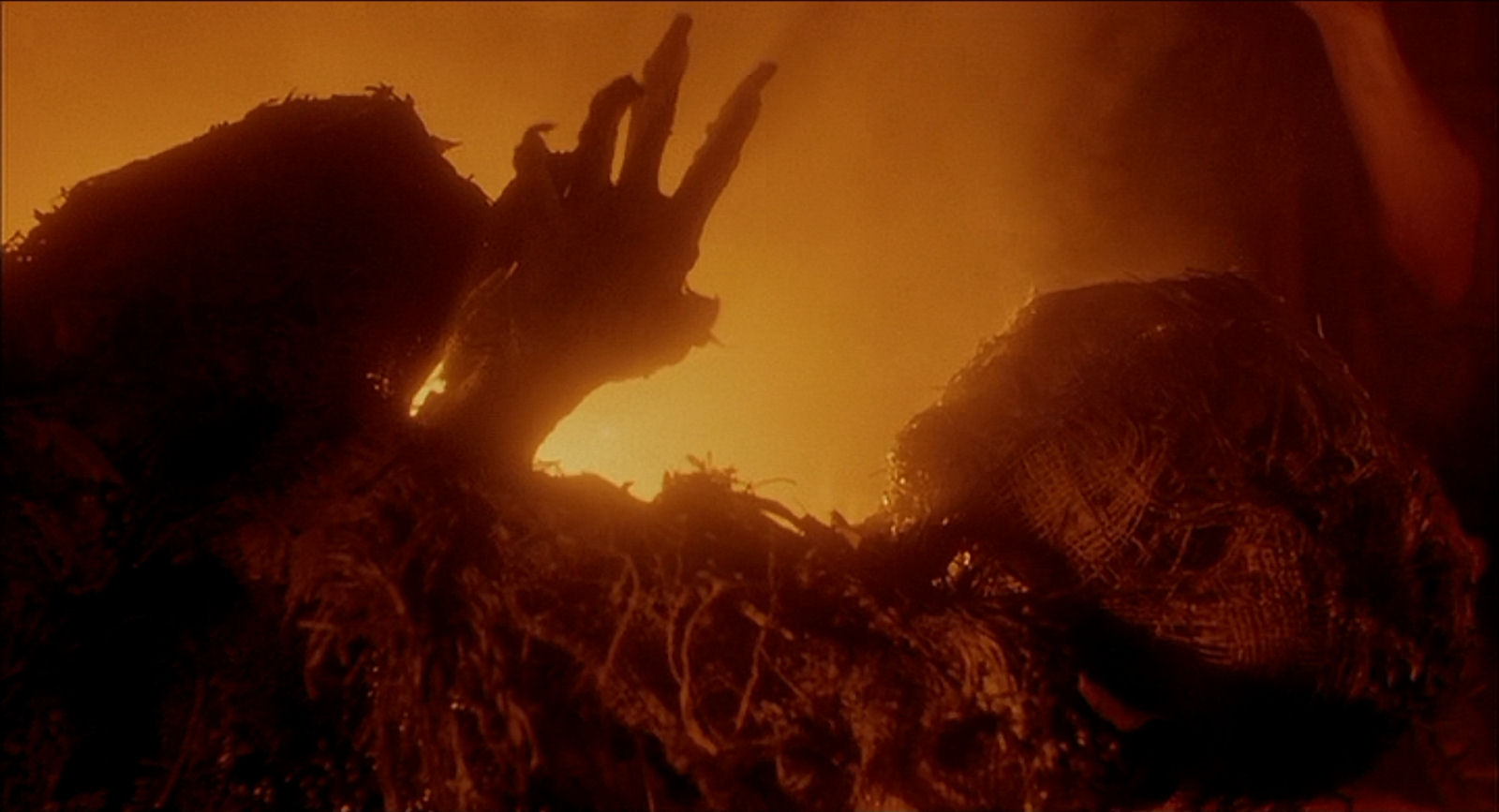
I know I can be a little snarky (to say the least) but if you were to ask me who my favorite monster was, the answer wouldn’t be myself; it would be Pumpkinhead.  The thing is awesome.  It’s such a huge creature, easily overpowering anyone gutsy enough to stand before it.  It has big powerful limbs and long, sleek, reptilian fingers with sharp nails protruding from each digit.  Its head is rather swollen, but is not actually a pumpkin.  The legend of the beast doesn’t even incorporate the shape of its head as the reason behind its name.  They call it Pumpkinhead because it comes from the old “pumpkin Patch Graveyard”.  The only other backstory we get about this graveyard is from a bit of exposition from Haggis.  She tells us that the graveyard is actually called “Razorback Hollow” and it’s the place where Mountain folk used to bury his kin in there.  “Kin they’s ashamed of,” she says.  The demon requires a vessel to enter this plane of existence, so his body is actually a possessed corpse dug up from the graveyard, transformed into the creature’s demonic manifestation.  This is the one thing I can say that I have over this creature; he requires help to cross through other worlds and astral bodies and I can travel through closets.

This movie’s art and lighting departments are really stellar.  I can actually get sucked into this world because the environment looks and feels real.  This is because the lighting and art department worked as a team to create the film’s customized feel and suspense.  The scenery, props and (as stated before) the monster are all wonderfully stylized works of art, but what makes it all feel as authentic as it does is how little we see of it.  This was achieved with a plethora of shadow play and an overall high contrast for most of the suspenseful sequences.  But shadows aren’t the only tool the DP is uses to create suspense; he also uses an interesting color pallet to make the setting distinctive.  This includes a great deal of oranges and reds for interior shots and blues and blacks for night exterior shots.  This use of color and forced perspective allows the audience’s imagination to run wild.  What is the back-story to this creepy ass graveyard?  Do all demons look like Pumpkinhead?  How did this evil witch get so evil?  And despite these questions, I am still thoroughly entertained.  That is the sign of a good movie to me; it takes me somewhere, brings me back, gives me at least a chill and leaves me satisfied, but still wanting more.

Pumpkinhead is one of the most under rated horror films I have ever seen.  Do yourself a favor and get a copy.  But heed my words, avoid the sequels.  They have nothing to do with this gem and only serve to muddy the franchise.  If you'd like to get yourself a good Pumpkinhead fix, read the Dark Horse comic book Pumpkinhead, the Rites of Exorcism.  It was a direct spinoff of the movie.  Only two comic books were released, even though it was written as a four parter.  Because of this, it ends on a cliffhanger, but I gotta say it's well worth the incredibly short read for any die hard fan.  But for you real hardcore die hard fans, here is the original poem, which sparked the creation of this wonderful movie.

Keep away from Pumpkinhead,
Unless you're tired of living,
His enemies are mostly dead,
He's mean and unforgiving,
Laugh at him and you're undone,
But in some dreadful fashion,
Vengeance he considers fun,
and plans it with a passion,
Time will not erase or blot,
A plot that he has brewing,
It's when you think that he's forgot,
He'' conjure your undoing,
Bolted doors and windows barred,
Guard dogs prowling in the yard,
Won't protect you in your bed,
Nothing will, from Pumpkinhead.

~Ed Justin

Eloquent words, if I do say so myself.